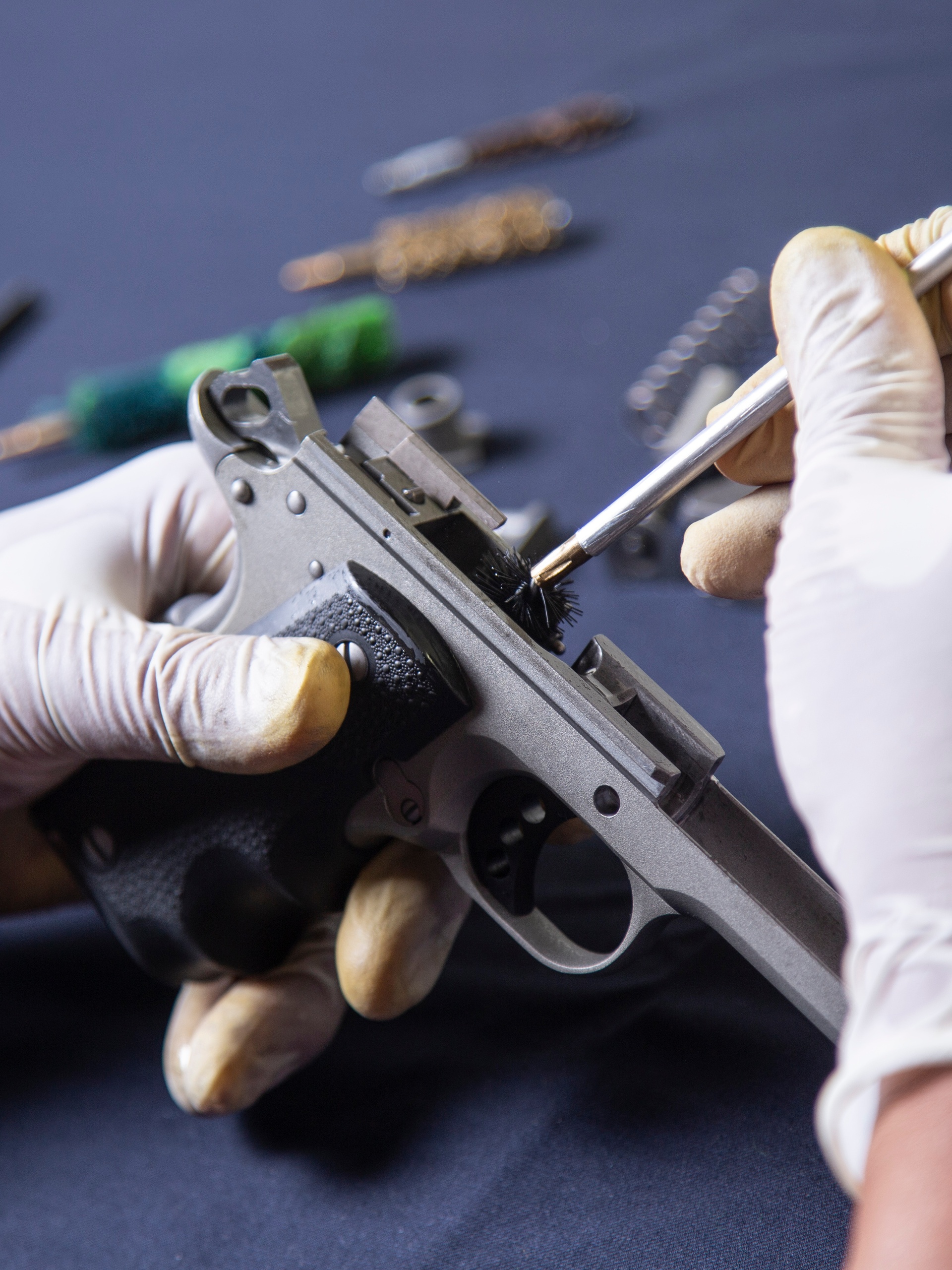
Guns are fairly intricate devices beneath their exterior. More components work together than most people realize, and any one of them can wear down or break with enough use. When a gun is damaged or breaks, you may wonder—what do gunsmiths do to get that firearm back in working order again? Let’s look at some common methods gunsmiths utilize to repair common problems with firearms like cracked frames and worn barrels.
TIG Welding Fills Cracks and Restores Metal
For certain structural repairs, there’s no substitute for TIG welding. TIG welding is a hot welding process that involves a tungsten electrode and a shielding gas to produce a precise, clean weld. On firearms, gunsmiths use it to fill cracks in receivers, repair broken lugs, and rebuild worn metal surfaces. The controlled heat keeps surrounding components from warping.
Stock Repair Brings Broken Wood Back Together
A cracked or split stock doesn’t mean the firearm is done. Gunsmiths assess how deep the damage runs before deciding whether to re-bond the wood or replace the stock entirely. For surface cracks, a strong wood adhesive under pressure can restore the stock to a stable, functional condition. If the break runs through a structural area near the action, the repair gets more involved—but it’s still doable in skilled hands.
Barrel Work Addresses Wear and Obstruction Damage
Barrels take a beating over time. Gunsmiths inspect them for erosion near the chamber, pitting along the bore, and any deformation from obstructions. Depending on the damage, a gunsmith may re-crown the muzzle, rechamber the barrel, or replace it entirely. A compromised barrel affects accuracy and safety, so this isn’t an area where partial fixes hold up long-term.
Spring Replacement Restores Reliable Function
Springs are small, but a weak or broken one can make a firearm completely non-functional. Trigger springs, recoil springs, and magazine springs all fatigue with repeated cycling. Gunsmiths swap them out with spec-correct replacements to bring the action back to proper tension. The fix is straightforward, but identifying which spring is failing requires a thorough function check first.
Timing and Fitting Repairs Solve Action Problems
Revolvers and semi-automatics both depend on tight mechanical timing. If the cylinder doesn’t lock up at the right point, or the slide isn’t cycling fully, the firearm won’t run as intended. Gunsmiths diagnose these issues by cycling the action slowly and checking where the breakdown happens. From there, worn parts get replaced and the action gets fitted back to the right tolerances.
Good Repairs Keep Working Firearms Working
A damaged gun isn’t automatically a lost cause. Gunsmiths work through a range of firearm repair techniques—welding, refitting, refinishing, replacing—to bring a firearm back to safe, functional condition.

Casey Cartwright
Latest posts by Casey Cartwright (see all)
- How To Build the Ultimate Private Hunting Property – October 1, 2026
- Building a Practical Setup for Hunting & Outdoor Recreation – October 1, 2026
- How To Maintain a Trailer for Hunting Season – October 1, 2026

Leave a Reply